
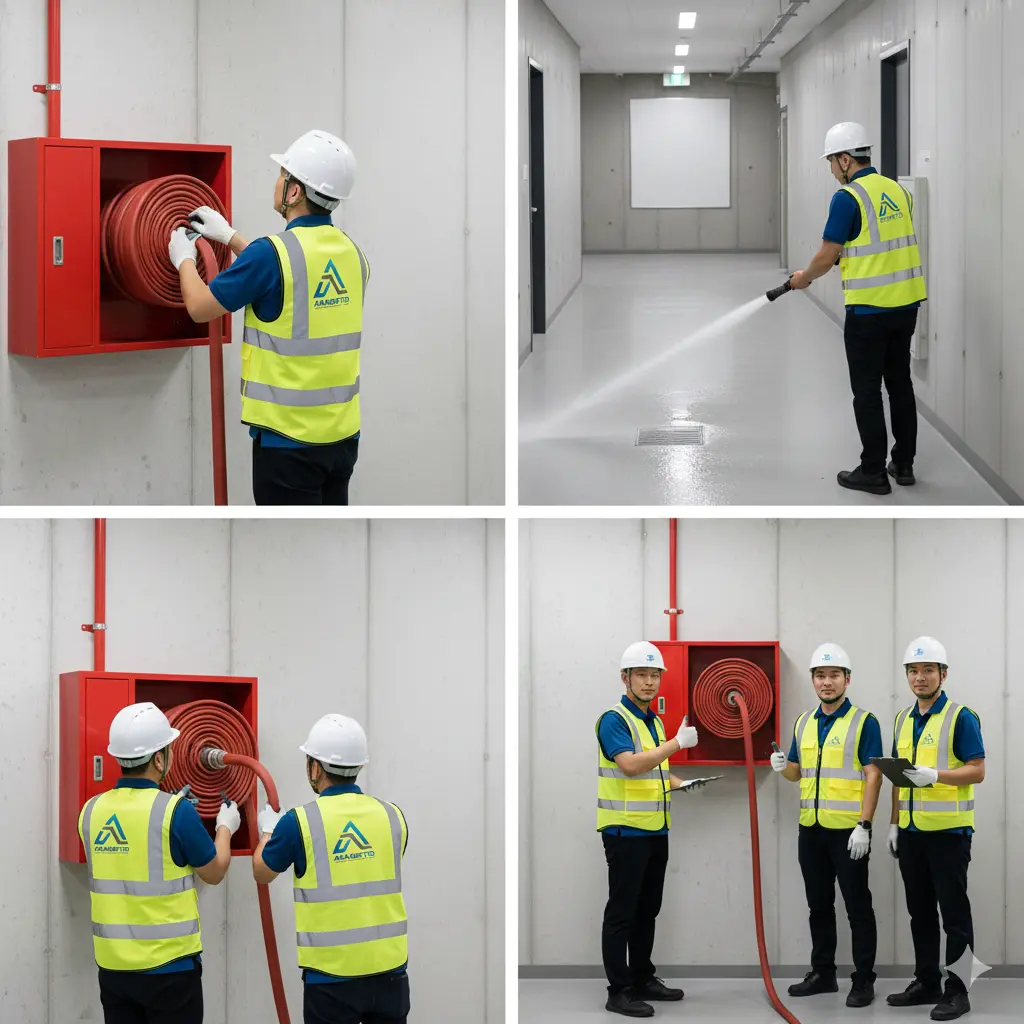
Passive Fire Protection (PFP) consists of built-in fire-resistant systems designed to contain fire and smoke within a defined compartment for a specified duration. Unlike active systems (sprinklers, alarms), PFP does not require activation — it works automatically by its physical and chemical properties.
Its primary objective is to:
- Prevent fire spread between compartments
- Protect structural integrity
- Provide safe evacuation time
- Limit property damage
1) Fire Stop & Sealant
Fire stopping systems seal openings and penetrations in fire-rated walls, floors, and ceilings caused by pipes, cables, ducts, and structural joints.
Key Functions:
- Restores fire rating of penetrated barriers
- Prevents flame and smoke spread
- Expands under heat (intumescent action) to close gaps
- Maintains compartmentation integrity
Applications:
- Electrical cable trays
- Plumbing pipe penetrations
- HVAC duct penetrations
- Expansion and movement joints
Proper installation must match tested and certified fire-rating assemblies (e.g., 1-hour, 2-hour, 4-hour ratings).
2) Fire-Resistant Coatings & Treatments
Fire-resistant coatings, often intumescent paints or cementitious sprays, are applied to structural elements such as steel beams and columns to improve fire endurance.
How It Works:
- Under high heat, intumescent coatings expand to form an insulating char layer
- Slows temperature rise in steel structures
- Maintains load-bearing capacity during fire exposure
Common Uses:
- Structural steel protection
- Industrial facilities
- Commercial buildings
- High-rise structures
Key Benefits of Passive Fire Protection
- No mechanical activation required
- Long-term structural protection
- Compliance with fire safety codes
- Reduced risk of catastrophic structural failure
Correct product selection, certified installation, and periodic inspection are critical to maintaining performance over the building lifecycle.

Comments are closed